2026-09-12 ·
Can Water Damaged Hardwood Floors Be Saved?
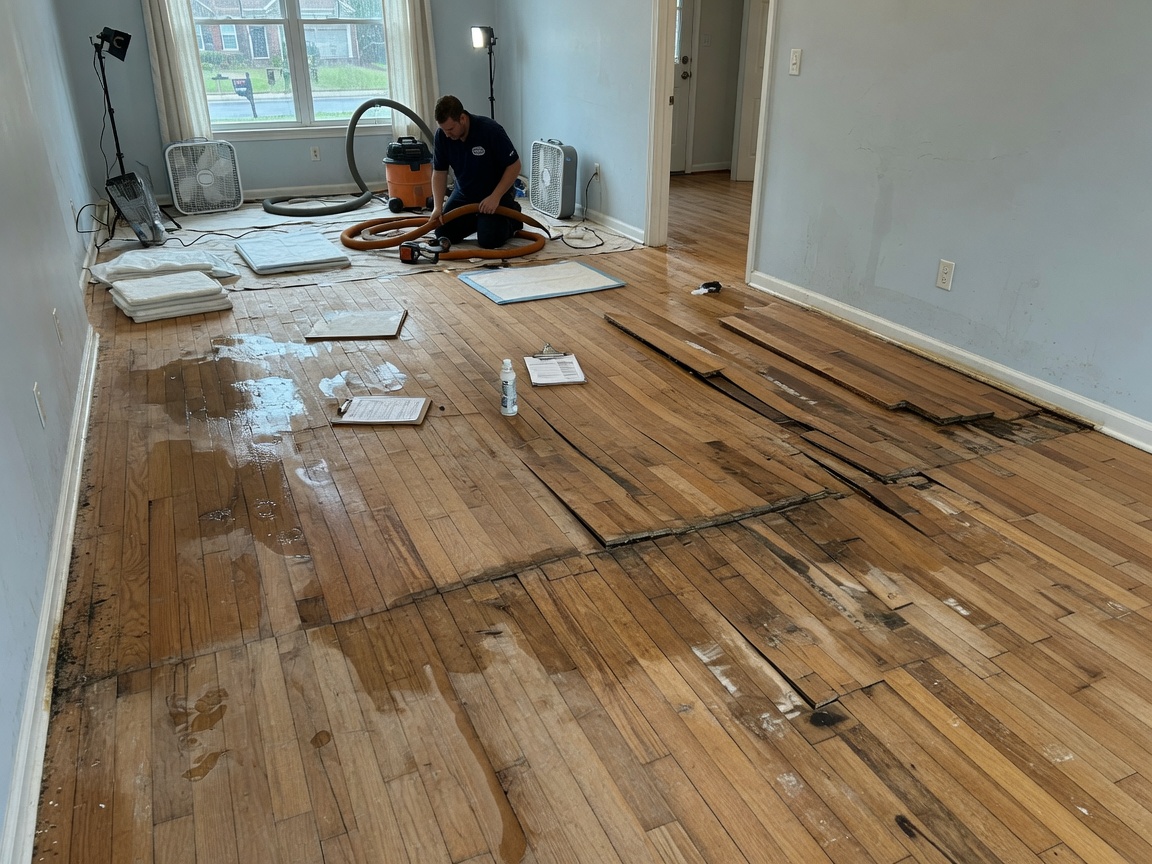
Water damaged solid hardwood can usually be saved if specialised drying starts within roughly the first day or two, and cupping frequently reverses on its own as the boards dry evenly. Engineered wood has much poorer odds, because once water gets between its bonded layers the delamination is not reversible by drying. That distinction, solid versus engineered, is the first thing to establish and it changes the entire conversation.
Cupping happens because a board absorbs water on its unfinished underside faster than the finished top face can release it. The bottom swells more than the top, the edges rise relative to the centre, and the floor develops that washboard feel. In the early stage this is a moisture gradient rather than permanent damage, and removing the moisture evenly lets the board return to flat. Left long enough, or dried unevenly, the board sets in a deformed shape or crowns in the opposite direction.
Ordinary air movers largely fail on wood floors and it is worth understanding why. The finish on the surface is a vapour retarder, and the water is underneath it. Blowing air across the top removes very little. Specialised floor drying systems solve this by sealing panels or mats to the surface and applying negative pressure, drawing air and moisture up through the board and the seams. Where there is a crawl space or an open basement ceiling below, drying from underneath is often more effective still, and on a serious loss both are used together.
The subfloor is the part people forget. A hardwood floor cannot dry while sitting on a wet plywood subfloor, because the subfloor keeps feeding moisture back into the underside of the boards. Readings have to cover both, and on a floor over a crawl space the joists and band board matter too. A drying plan that addresses only the visible wood is going to fail, which is why moisture mapping covers the assembly rather than the surface.
Then the mistake that ruins recoverable floors: sanding too early. A cupped floor sanded flat while it is still wet will crown once the boards finish drying and shrink back, because material was removed from the raised edges that the board then needs. The whole floor has to be refinished a second time, and there is only so much thickness available in a wear layer. Wait until moisture content matches unaffected boards elsewhere in the house before any sanding decision, even if that means living with a cupped floor for a fortnight. Our guide on how long structural drying takes explains how that end point is measured.
The realistic outcomes, in order. Dried inside the window and the floor returns flat with no refinishing. Dried slightly later and the floor comes back mostly flat and needs a sand and refinish. Wet for a week or more and the boards have taken a set, so refinishing is needed and some replacement is likely. Buckled and lifted off the subfloor, or engineered and delaminated, and it is replacement of the affected area. Which of those you land in is decided almost entirely in the first 48 hours, which is why emergency extraction on day one matters more than anything that happens later.