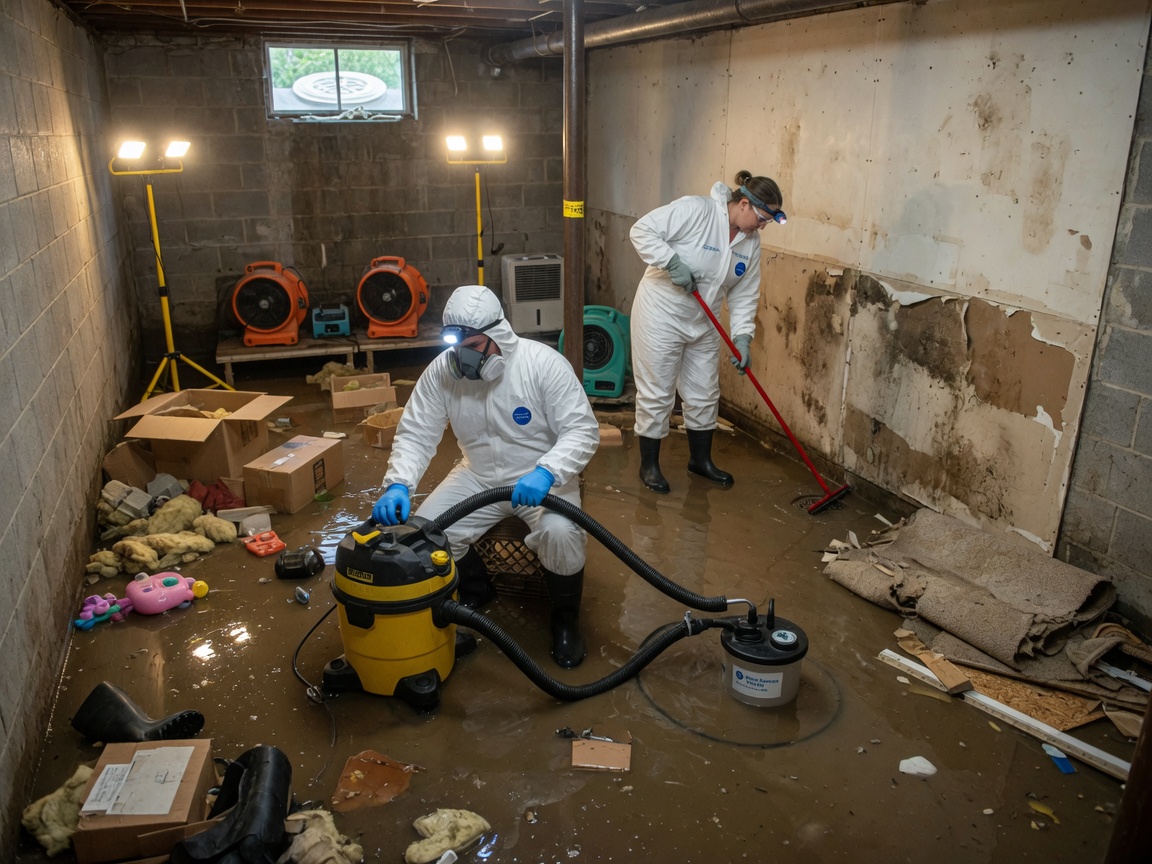
A flooded basement in Fairfax County usually has one of four causes, and they call for different work. A failed sump pump during a storm produces clean groundwater that turns contaminated fast. Hydrostatic pressure through the slab edge or a cold joint produces slow seepage across a wide area, which soaks carpet and pad without ever looking dramatic. A burst supply line upstairs sends clean water down through the ceiling. A floor drain backup is Category 3 sewage from the first second.
Piedmont clay is the reason so many of these are groundwater events rather than plumbing events. Clay holds water instead of draining it, so after a sustained rain the soil around the foundation stays saturated and the pressure has to go somewhere. Homes in Burke, Springfield and Annandale with 1960s and 1970s foundations tend to show it at the cold joint where the wall meets the slab. Newer basements in Chantilly and Ashburn more often show it at a failed sump discharge line that froze or clogged. Our guide on why Fairfax County basements flood during heavy rain sets out how to tell which cause you have.
Finished basements are the expensive version. Carpet and pad, drywall bottom plates, baseboard, cabinetry toe kicks and any built-in shelving sitting on the slab all wick water upward. Drywall pulls water up the paper facing well above the visible line, which is why a flood cut is usually made at 12 or 24 inches rather than at the waterline. Insulation in the wall cavity behind it holds water even when the drywall surface reads dry, and the carpet question is covered on our carpet water damage page.
The drying problem in a basement is different from an upstairs room. Below grade spaces run cool and there is no dry outside air to bring in when the whole region is humid, so open windows make it worse. This is closed drying: seal the space, run low grain refrigerant dehumidification, and let the equipment control the vapour pressure rather than the weather.
Where a basement flood was not caught quickly, or was dried without proper verification, growth follows and that becomes a basement mold job instead. That is the outcome the first 48 hours are spent avoiding, and it is why the extraction and drying sequence matters more than anything that happens afterwards.
Technician insight
Check the sump discharge line outside before blaming the pump. In Fairfax the failure is frequently a discharge that terminates too close to the foundation, so the pump faithfully moves water out and the soil delivers it straight back to the same sump. The pump is fine, the loop is the problem.
Flooded Basement Cleanup Services We Offer
✓Sump Pump Failure Flooding
Extraction plus diagnosis of why the pump failed, which is usually a stuck float, a seized motor or a blocked discharge.
✓Groundwater Seepage Cleanup
Wide area slow seepage through slab edges and cold joints, which soaks flooring without visible standing water.
✓Finished Basement Restoration
Flood cuts, insulation removal, cavity drying and reinstatement of drywall, trim and flooring.
✓Storage and Contents Recovery
Sorting, drying and inventory of stored contents on the slab, which take the worst of any basement flood.
How it works
- 1
Find why it flooded
Sump, discharge, grading, downspout, cold joint or plumbing. Drying without answering this means doing it again next storm.
- 2
Extract and demolish
Water out, pad out, flood cuts where drywall is saturated above the visible line.
- 3
Closed drying
Space sealed, dehumidification sized to volume and class, air movers directed across wet surfaces.
- 4
Verify and rebuild
Readings matched to a dry standard, then insulation, drywall, trim and flooring reinstated.