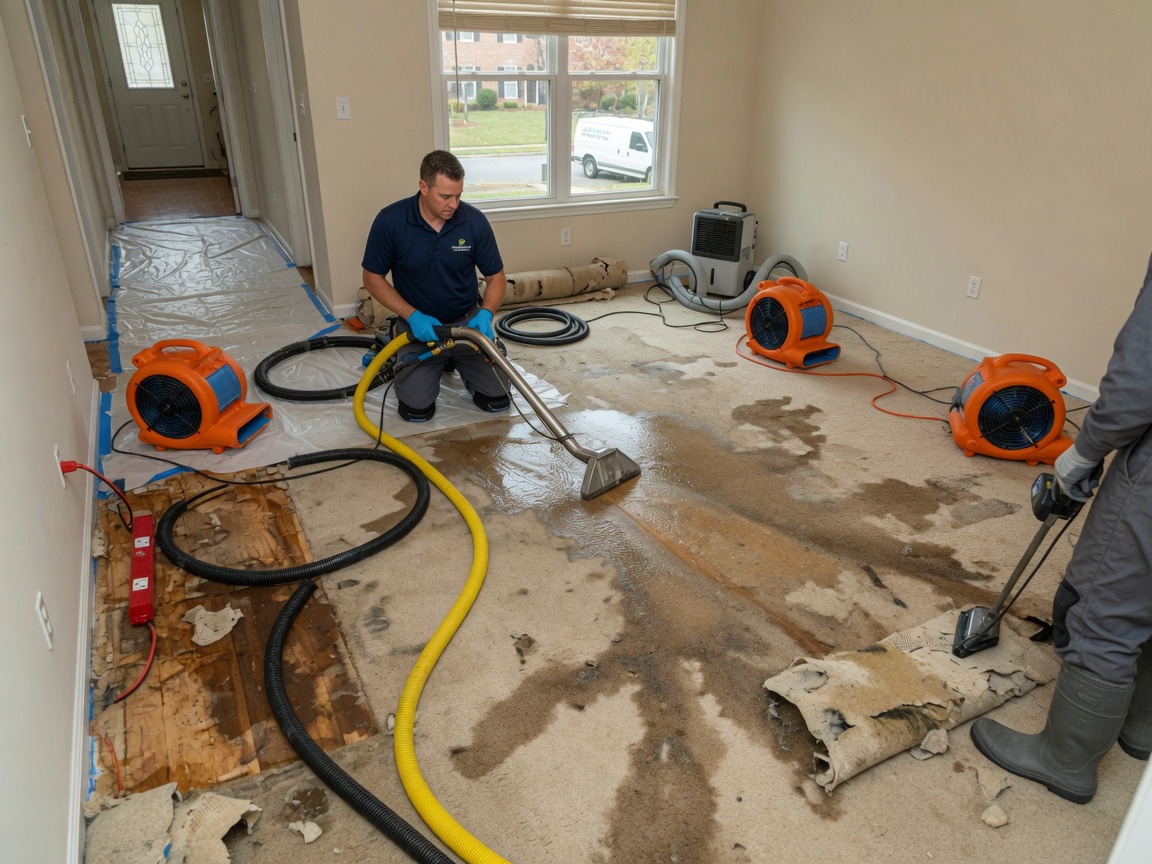
Wet carpets are two separate problems wearing one surface. The carpet itself is a face fibre on a woven backing, it holds a moderate amount of water, and on a clean water loss it can usually be extracted, floated, dried and kept. The pad underneath is an open cell foam or rebond sponge that holds many times its own weight in water, sits directly on the subfloor with no airflow, and is cheap to replace. On almost every job, the carpet stays and the pad goes.
Extraction technique decides whether the carpet survives. A weighted extraction head, worked slowly in overlapping passes, pulls far more water than a wand skimmed across the surface, and the difference is measured in drying days. Once extraction stops yielding water, the carpet is detached at one edge, floated with air movers directing air underneath it, and dried from both faces at once. Trying to dry a carpet from the top with the pad still under it does not work.
Category is the hard line. On clean supply water the plan above applies. On Category 2 the pad goes and the carpet is assessed, usually with antimicrobial treatment. On Category 3, sewage or groundwater, both carpet and pad are removed and disposed of, because the backing and the pad hold contamination in a structure that cannot be cleaned back to safe. There is no version of this where a sewage soaked carpet is saved, and any contractor offering to clean one should be treated with suspicion.
Two details cost people carpets after the water is gone. Furniture legs left standing on wet carpet transfer wood stain and metal rust into the fibre within hours, and those marks are permanent. And carpet left wet under a rug or against a wall while everything else dries will delaminate, where the backing separates from the face fibre and the carpet goes wavy and never lies flat again.
Technician insight
Get foil or plastic tabs under every furniture leg within the first hour. Wood stain and rust bleeding out of furniture feet into wet carpet is permanent, it happens fast, and it ruins carpets that the water itself would not have. It is the cheapest thing anyone can do on a wet carpet and it is almost always skipped.
Carpet Water Damage Restoration Services We Offer
✓Wet Carpet Extraction and Float Drying
The standard clean water process, keeping the carpet and replacing the pad.
✓Pad Removal and Replacement
The pad is a sponge and it does not dry reliably in place, so it comes out on nearly every job.
✓Subfloor Drying Under Carpet
Drying the plywood or concrete beneath, which is the surface that actually has to reach standard.
✓Area Rug Recovery
Wool, silk and specialist rugs assessed and sent for appropriate cleaning rather than dried in place.
How it works
- 1
Classify
Water category decides whether the carpet is a salvage job or a removal job.
- 2
Extract properly
Weighted head, overlapping passes, continuing until the carpet stops giving up water.
- 3
Float and dry
Pad out, carpet detached and floated, air moving across both faces, subfloor read daily.
- 4
Reinstate
Carpet re-stretched and refitted over new pad once the subfloor meets a dry standard.