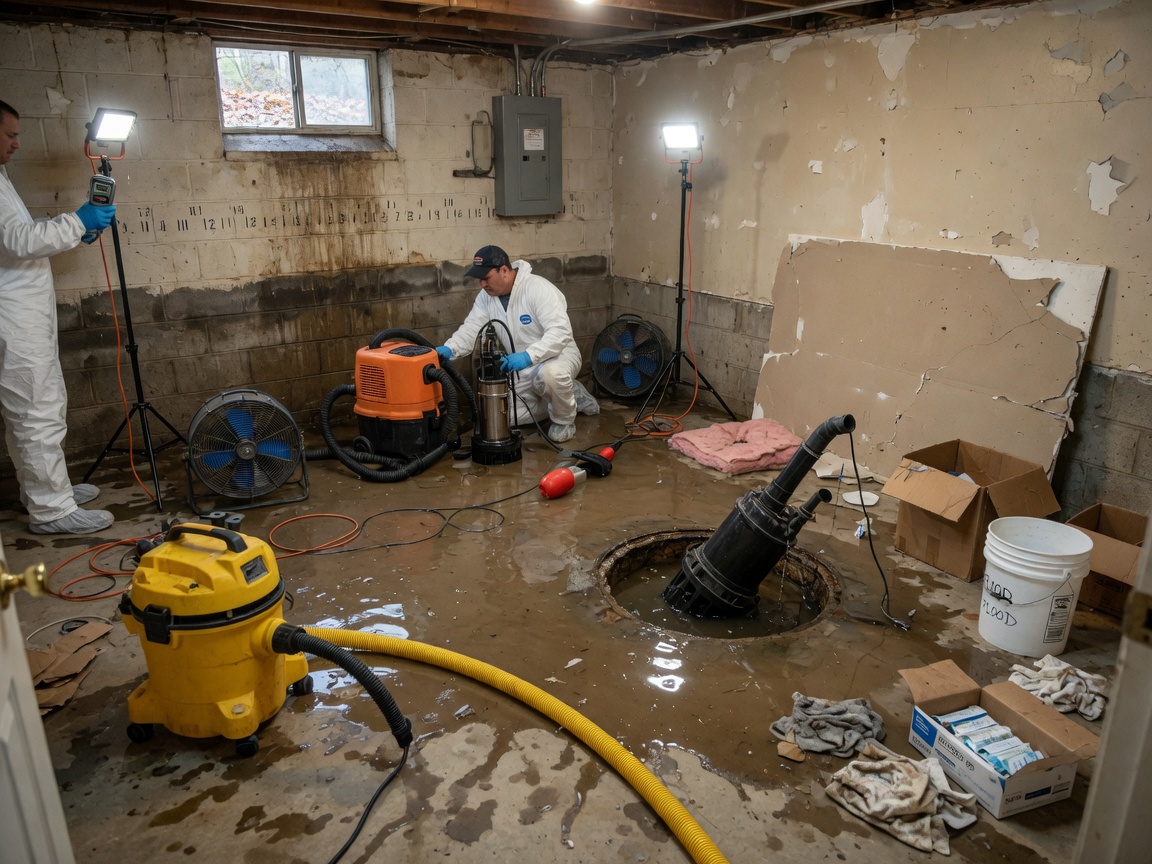
Sump pumps fail at the worst possible moment because that is when they are working hardest. During a sustained Northern Virginia rain the pump may cycle every ninety seconds for hours, and a motor, float switch or check valve that was marginal in dry weather gives up under that load. Power loss during the same storm produces an identical result with a perfectly healthy pump.
The four failure modes we find, roughly in order: a float switch stuck against the basin wall or tangled on the discharge pipe, a seized or burned out motor, a discharge line blocked by ice, debris or a collapsed section, and a check valve that failed open so the same water drains back into the basin and the pump runs until it overheats. A fifth, less common but worth checking, is a pump undersized for the volume the perimeter drain is actually delivering.
The water itself starts as Category 1 groundwater and does not stay that way. Once it has sat on a basement slab, mixed with whatever is stored down there and moved through a floor drain area, it is Category 2 at best. Time matters as much as source here.
Cleanup is extraction, then closed system drying, then an honest look at why it failed. Replacing a pump without checking the discharge run and the basin inflow rate means the next storm produces the same call.
Technician insight
Walk the discharge line to its termination before writing off the pump. Roughly a third of the sump failures we attend in Fairfax turn out to be a discharge that ends within a few feet of the foundation, so the pump moves water out and the clay soil returns it. The basin refills as fast as the pump empties it and the motor cooks.
Sump Pump Failure Cleanup Services We Offer
✓Storm Flooding Extraction
Bulk water removal after a pump has been overwhelmed or has stopped during heavy rain.
✓Failure Diagnosis
Identifying which of the failure modes occurred, so the fix addresses the actual cause.
✓Discharge Line Assessment
Checking for freezing, blockage, collapse and termination too close to the foundation.
✓Backup System Guidance
Plain advice on battery backup and secondary pump options for basements that cannot afford a second failure.
How it works
- 1
Extract
Standing water out first, because everything else is easier on a dry slab.
- 2
Diagnose
Basin, float, motor, check valve and discharge line checked in sequence.
- 3
Dry
Closed drying sized to the basement volume, readings logged daily.
- 4
Prevent
Findings written up, including grading and discharge issues that will cause a repeat.