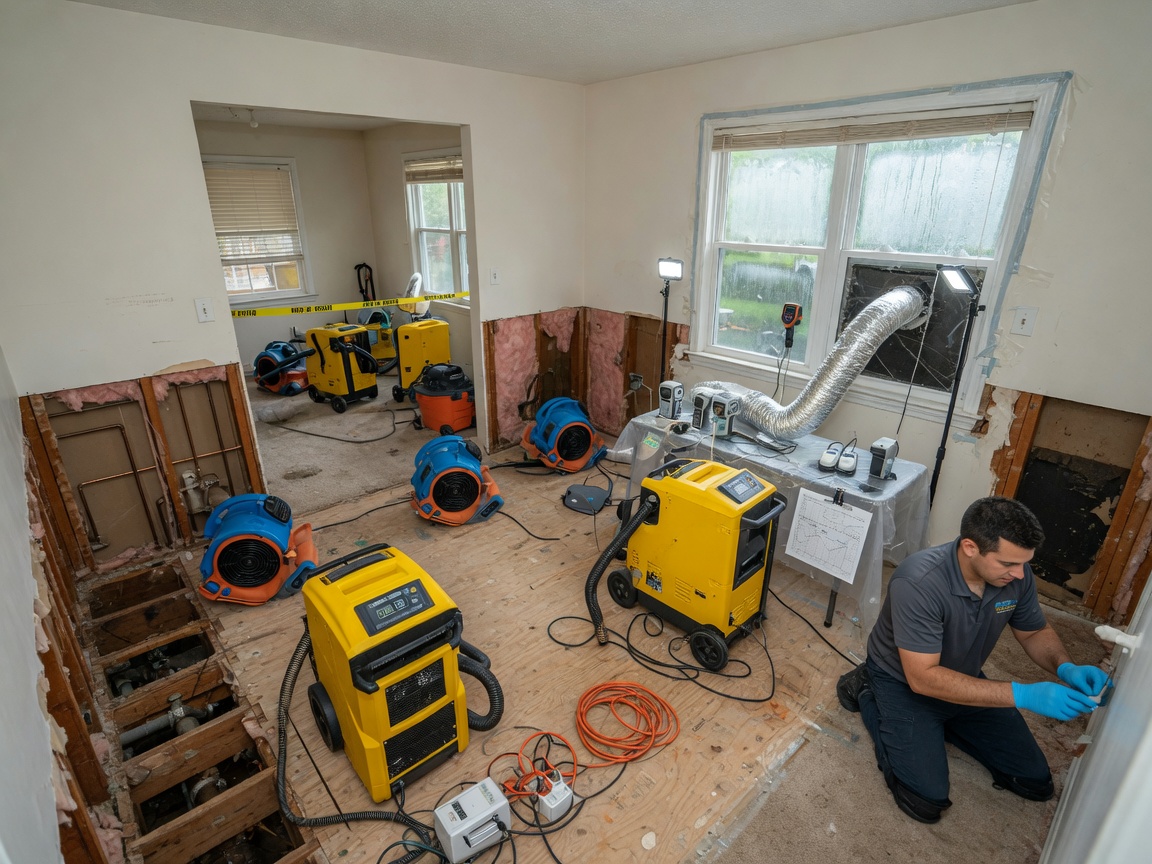
Drying a structure is a physics problem with three variables: how much water is still in the materials, how fast the air can carry vapour away from those materials, and how fast the dehumidification can pull that vapour back out of the air. Get the balance wrong in either direction and you either dry too slowly, which invites mold, or you overdry surfaces while the cavity behind stays wet.
Equipment is calculated, not guessed. IICRC S500 defines four classes of loss based on how much of the space is wet and how porous the wet materials are, and the class determines the dehumidification capacity and airflow needed for the cubic footage involved. A Class 1 loss in a small room needs one dehumidifier and two air movers. A Class 4 loss involving saturated hardwood, plaster or concrete needs specialty equipment and considerably longer, because dense materials release water slowly no matter how much airflow you throw at them.
Dehumidifier ratings mislead people. A unit rated at 130 pints per day is rated at AHAM conditions, which is 80 degrees Fahrenheit and 60 percent relative humidity. A Fairfax basement in October sits nowhere near that, and the same unit will pull a fraction of its rated capacity. Low grain refrigerant units perform better in cool low humidity conditions, which is most of what we work in here, and that is why they are the default rather than a consumer unit from a hardware store.
Dry is defined by measurement. We take a dry standard reading from unaffected material of the same type elsewhere in the building, then dry the affected material until it reads within range of that standard. Gypsum, framing and subfloor have different targets and get measured separately. Readings are logged daily and the log goes to your adjuster.
Technician insight
Take the dry standard reading before you place a single machine. Without it you have no target, and the most common consequence is equipment pulled a day early because the surface felt dry. On gypsum in particular, the face can read acceptable while the core is still well above the standard.
Structural Drying Dehumidification Services We Offer
✓Cavity Drying
Directed airflow into wall cavities through small access points, avoiding a full flood cut where the water category allows.
✓Hardwood Floor Drying
Mat systems pulling moisture up through the finish, used inside the window before cupping becomes permanent.
✓Desiccant Dehumidification
For cold or very low humidity conditions where refrigerant units lose efficiency.
✓Documented Moisture Monitoring
Daily readings by material type, logged and supplied for the claim file.
How it works
- 1
Classify
Class of loss determined from affected area and material porosity.
- 2
Calculate
Dehumidification and air mover count sized to cubic footage and class, not to what fits in the truck.
- 3
Place and contain
Equipment positioned for airflow across wet surfaces, with containment where it helps.
- 4
Monitor and adjust
Daily readings, equipment relocated as the wet area shrinks, removed when readings clear.