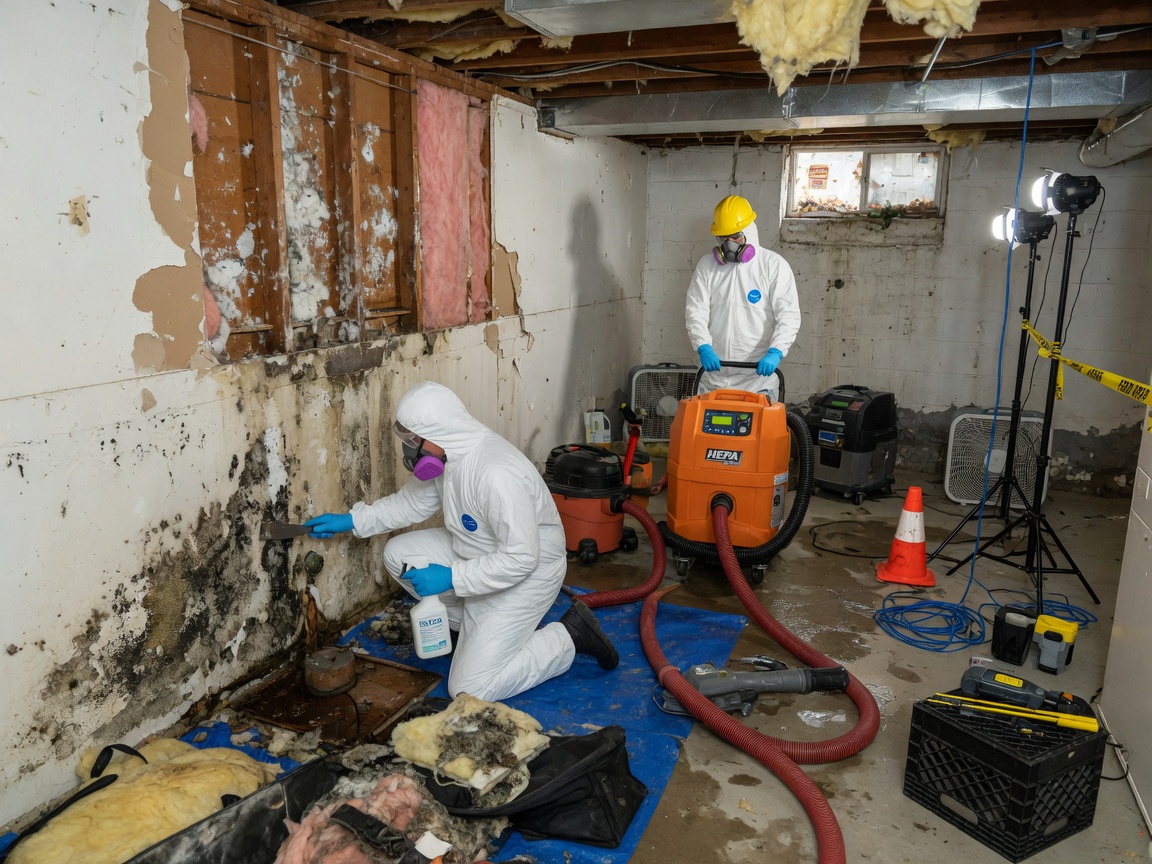
Basements grow mold for reasons that have nothing to do with a dramatic flood. Below grade walls stay cool year round because the surrounding soil is cool. Warm humid air, which Northern Virginia has in abundance from May through September, meets that cool surface and condenses on it. That condensation is a continuous slow water supply, and drywall paper on a furred out basement wall is a continuous food supply. No leak required.
The leak version exists too, and in Fairfax County it is usually hydrostatic seepage at the wall to slab cold joint, a failed sump, or a window well that fills during heavy rain and pushes water past the frame. These produce growth low on the wall in a defined band, whereas humidity driven growth is patchier and appears behind furniture, inside closets and on the cool side of any surface with poor air movement.
The fix has two halves and skipping either one wastes the work. Remove the affected material under containment with negative air, HEPA vacuum and wipe what remains, treat framing where growth has penetrated. Then bring the humidity under control, which in a Fairfax basement means keeping relative humidity in the range where growth cannot establish, usually with a properly sized dehumidifier running continuously rather than a consumer unit emptied when someone remembers.
Finished basements complicate this because the growth is often behind the finish rather than on it. Drywall grows mold on the cavity side first, where the humidity is higher and there is no air movement at all. A wall that looks clean can be heavily affected behind, and the musty smell with no visible cause is usually exactly this.
Technician insight
Pull one carpet corner in the coolest part of the basement before scoping anything. Humidity driven growth almost always shows on the pad underside before it shows on a wall, and that single check tells you whether you are dealing with a localised leak or a whole space humidity problem.
Basement Mold Cleanup Services We Offer
✓Behind the Wall Inspection
Investigating musty odour with no visible growth, where the affected side is the cavity face.
✓Cold Joint Seepage Remediation
Growth banded low on the wall from hydrostatic intrusion at the slab junction.
✓Window Well Water Damage
Growth around basement windows where the well fills and pushes water past the frame.
✓Humidity Control Planning
Dehumidification sizing and placement so the space stays out of the growth range year round.
How it works
- 1
Diagnose the moisture
Humidity, seepage or leak. The three call for different corrections.
- 2
Contain
Barriers and negative air, particularly important in basements where the HVAC return can distribute spores.
- 3
Remove and clean
Affected material out, masonry and framing HEPA vacuumed and wiped, wood treated where needed.
- 4
Control
Humidity brought into range and a plan set for keeping it there.