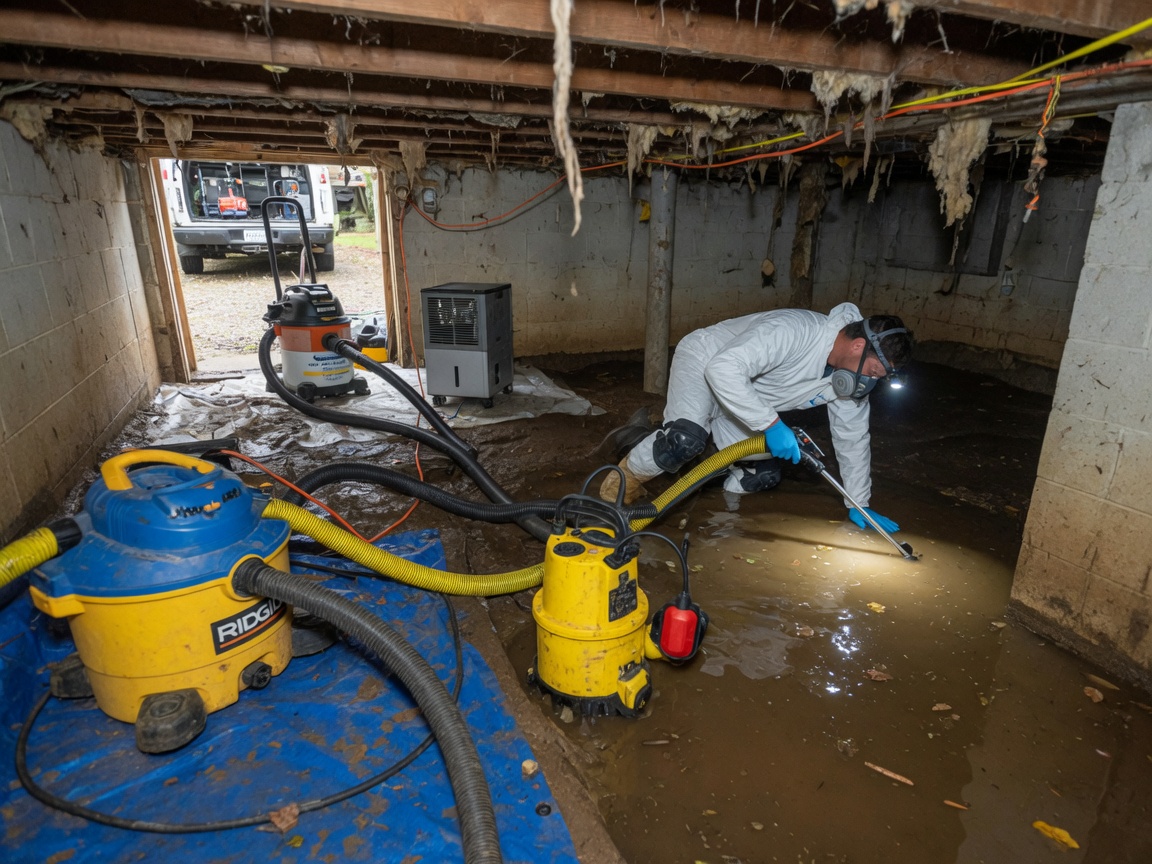
Crawl spaces are the water losses nobody discovers on time. There is no visible ceiling stain, no wet carpet and nobody goes down there. The signal usually arrives as a musty smell in the rooms above, cupping floorboards, or an HVAC system that has started distributing that smell through the whole house because the return or the ductwork runs through the crawl.
Water gets in three ways. Groundwater intrusion after heavy rain, which Piedmont clay makes worse by holding water against the foundation. A plumbing failure in the crawl, common where supply lines run through unconditioned space and freeze in a January cold snap. And condensation, where humid summer air enters a vented crawl space and condenses on cool surfaces including the underside of the subfloor.
The vapour barrier makes extraction harder and more necessary. A polyethylene barrier laid over the soil is doing its job when it stops ground moisture rising, but once water is on top of it, that same sheet holds the water in place against the joists and insulation instead of letting it soak away. Water on top of the barrier has to be pumped and extracted, and often the barrier itself is removed and replaced.
Fibreglass batt insulation stapled between the joists is a lost cause once it is wet. It holds water, it sags, it loses its rated value permanently, and it becomes a mold substrate. It comes out. Drying then focuses on the joists, subfloor and band board, which are the structural elements that actually matter.
Technician insight
Read the band board, not just the joists. It is the perimeter member that sits closest to the foundation and the last thing to dry, and it is where crawl space mold establishes first. If the joists read dry and the band board does not, the space is not dry and pulling equipment is premature.
Crawlspace Water Extraction Services We Offer
✓Groundwater Intrusion Cleanup
Water entering through foundation walls or the crawl floor after heavy or sustained rain.
✓Frozen Pipe Failure in the Crawl
Supply line breaks in unconditioned space during Northern Virginia freeze events.
✓Wet Insulation Removal
Saturated batts removed, since wet fibreglass never recovers its rating and becomes a mold substrate.
✓Vapour Barrier Replacement
New sheeting installed and sealed after the space is dry and clean.
How it works
- 1
Access and assess
Entry, standing water depth, insulation condition and framing readings recorded.
- 2
Extract
Pumping and extraction of water sitting on the barrier.
- 3
Strip
Wet insulation and contaminated barrier removed and bagged.
- 4
Dry and reinstate
Joists and subfloor dried to standard, then new barrier and insulation installed.