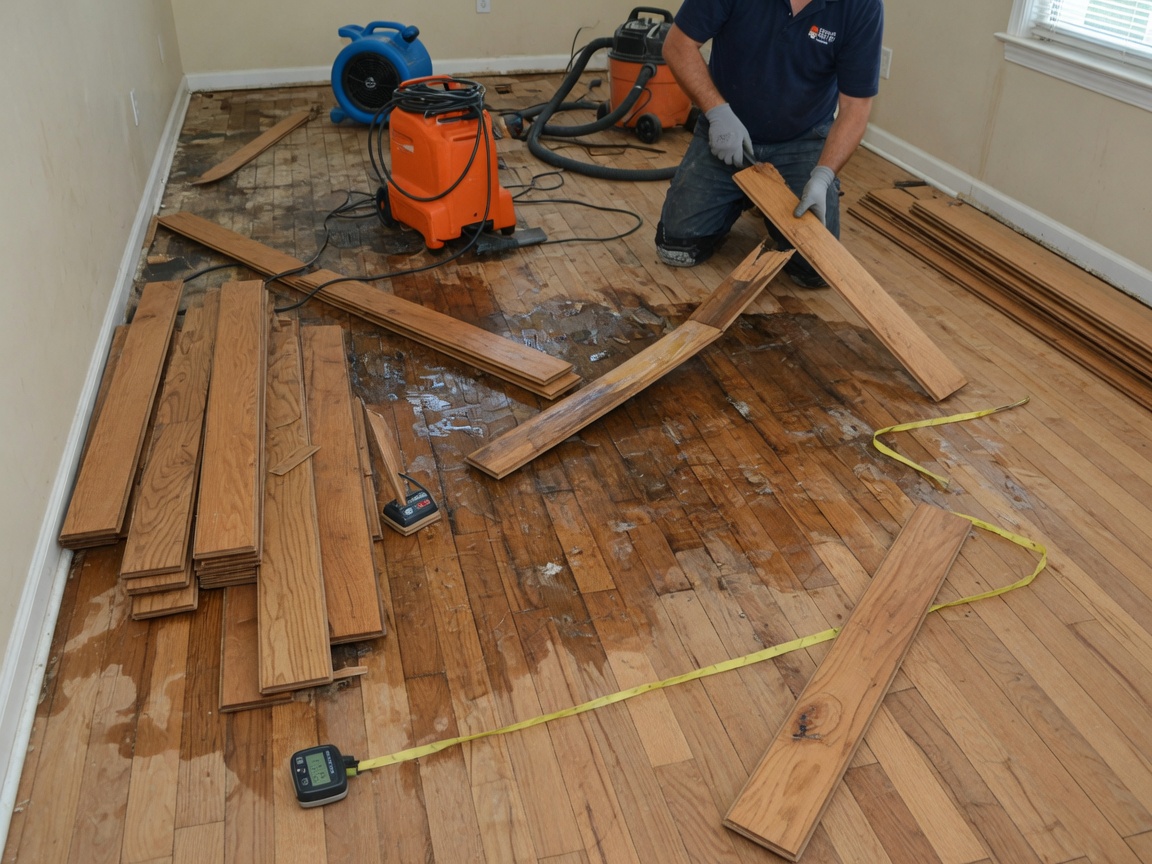
Hardwood absorbs water on its underside first, because that is the unfinished face and the finish on top slows evaporation from above. The board swells more at the bottom than the top, and that differential is what makes the edges rise relative to the centre. That is cupping, and in the early stage it is reversible. If the board dries unevenly afterwards, it can then crown, where the centre sits proud of the edges, and if the expansion has nowhere to go the flooring buckles and lifts off the subfloor entirely.
The window is short. Drying that starts within roughly the first day or two, before the moisture has fully equilibrated through the board thickness, gives the best chance of the floor returning flat without sanding. After that the odds fall, and once the floor has been wet for a week the realistic outcome is drying followed by sand and refinish, or replacement.
Standard air movers pointed at a wood floor mostly do not work, because the finish on top is a vapour retarder and the water is underneath it. Specialised floor drying systems solve this by sealing panels or mats to the surface and applying negative pressure, pulling air and moisture up through the board and the seams rather than waiting for it to migrate. On a floor over a crawl space or an open basement ceiling, drying from beneath is often the better route and sometimes both are used together.
Engineered wood is a different assessment. Its layers are bonded, and once water gets between them the delamination is not reversible by drying, so an engineered floor that has swelled at the seams is usually a replacement rather than a recovery. Solid hardwood has far better odds, which is worth knowing when a contractor tells you the whole floor has to come out.
Technician insight
Never sand a cupped floor until it has reached equilibrium moisture content. Sanding a wet cupped floor flat means that when the boards finish drying and shrink back, every board crowns and the whole floor has to be done again. Waiting the extra week costs nothing and saves the refinish.
Hardwood Floor Water Damage Repair Services We Offer
✓Cupped Floor Drying
Mat systems applied inside the window, before the cupping sets permanently.
✓Buckled Floor Assessment
Where boards have lifted off the subfloor and the question is partial or full replacement.
✓Subfloor Drying Under Wood
Drying the plywood beneath, which controls whether the finished floor can reach standard.
✓Sand and Refinish
Where drying leaves residual cupping or crowning, restoring the surface to flat.
How it works
- 1
Read and assess
Moisture content across the boards and subfloor, plus solid versus engineered construction.
- 2
Apply floor drying
Mats or panels sealed to the surface under negative pressure, drawing moisture up through the board.
- 3
Dry to equilibrium
Monitored to a moisture content matching unaffected boards elsewhere, not to a schedule.
- 4
Refinish if needed
Sanding and refinishing where cupping has not fully resolved once the floor is dry.