Mold is a moisture problem wearing a biology costume. Spores are present in every building in Fairfax County already, and they do nothing until they get water and a food source. Cellulose, meaning drywall paper, wood, cardboard and dust, is the food source. Remove the moisture and the growth stops. Remove the growth without removing the moisture and it returns, usually within weeks and usually in exactly the same place.
That is why every remediation we do starts with the water. If the source is a leaking supply line, a failed sump pump, a roof penetration or a crawl space with no vapour barrier, that gets identified and addressed before the containment goes up. Where the source is not obvious, leak detection comes first. A remediation report that does not name the moisture source is incomplete.
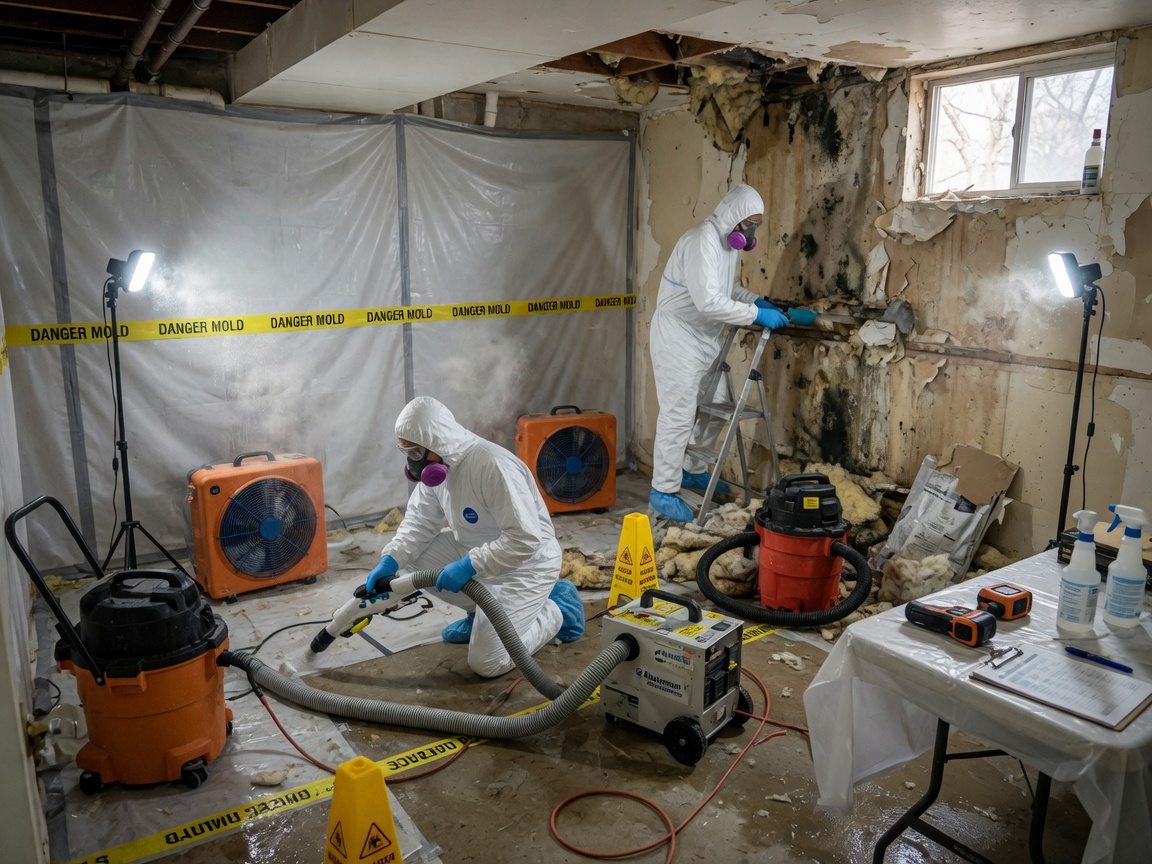
The removal work follows IICRC S520. The affected area is sealed under polyethylene containment with negative air pressure maintained by HEPA filtered air scrubbers, so spores disturbed during removal cannot travel into clean parts of the building. Non salvageable porous materials are removed and bagged inside containment. Remaining surfaces are HEPA vacuumed and damp wiped. Structural wood may be sanded or soda blasted where growth has penetrated the surface. An antimicrobial goes on last, not first, because applying biocide to material that is about to be removed accomplishes nothing.
Where the growth sits changes the method enough that these have their own pages. Below grade growth is covered under basement mold cleanup, growth on roof sheathing under attic mold removal, and growth under the house under crawl space mold remediation. Each of those is driven by a different moisture mechanism and the standard fix for one does not work on the others.
Virginia does not require a separate mold remediator licence, which is a real difference from states like Florida and Texas, and it means the quality bar is set by the contractor rather than by the state. Ask for the containment plan and the clearance criteria before work starts, from us or from anyone else. If you want to know whether sampling is worth paying for in your situation, mold inspection and testing sets out when it is and when it is not, and our guide on how quickly mold grows after water damage explains the window you are working against.
Technician insight
If the growth pattern is a clean horizontal line across a wall, you are looking at a water event with a defined level, usually a flood. If it is patchy and heaviest at the bottom plate and behind furniture on exterior walls, it is a condensation and humidity problem, and remediating without fixing the humidity guarantees a repeat call.
Mold Remediation Services Services We Offer
✓Black Mold Remediation
Stachybotrys and other heavily pigmented growth, handled under full containment and negative air.
✓HVAC and Duct Mold Remediation
Growth in the air handler and duct system, which distributes spores to every room on the system.
✓Structural Wood Treatment
Sanding or media blasting framing where growth has gone below the surface.
✓Post Remediation Verification
Visual inspection and, where wanted, third party air and surface clearance sampling.
How it works
- 1
Find the water
Moisture source located and a correction plan agreed. Everything else is temporary without this.
- 2
Contain
Barriers and negative air established before any material is disturbed.
- 3
Remove and clean
Porous material out, remaining surfaces HEPA vacuumed and wiped, structural wood treated where needed.
- 4
Verify
Visual inspection and moisture confirmation, with clearance sampling by an independent party where requested.