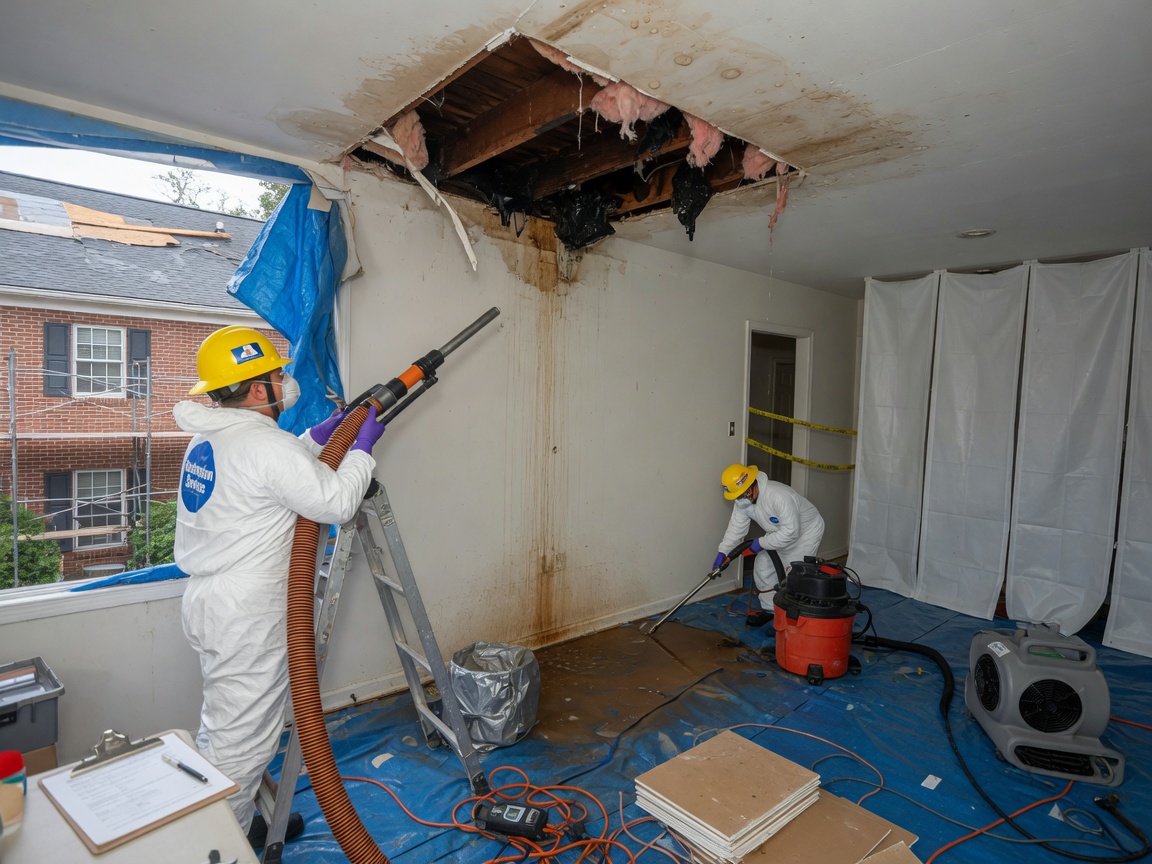
A roof leak produces damage in a sequence, and the visible ceiling stain is the last stage rather than the first. Water enters at a compromised point, usually flashing at a chimney, valley or sidewall rather than through the field of the shingles. It then runs down the underside of the sheathing, along a rafter, into the insulation, and only reaches the ceiling drywall once the insulation above it is saturated. By the time you see a stain, the attic has been wet for some time.
Northern Virginia produces two seasonal versions. Summer and autumn bring wind driven rain from thunderstorms and the inland remnants of tropical systems, which forces water past flashing and under shingle courses at angles the roof was never designed for. Winter brings ice damming, where snow melts over a warm attic, refreezes at the cold eave, and backs meltwater up under the shingles. Ice damming damage almost always appears along the outer edge of a room rather than in the middle.
First response is stopping the intrusion. Emergency tarping over the entry point buys time and is usually what the insurer expects you to have done. Then the attic gets assessed: saturated insulation removed, sheathing and rafters read with a meter, and the ceiling cavity dried before the drywall is touched. Drying a ceiling from below while wet insulation sits on top of it does not work.
Roof replacement is roofing work under a separate trade. We handle the tarping, the water damage and the interior restoration, and coordinate a licensed roofer for the permanent repair.
Technician insight
Find the entry point by looking uphill from the wet spot, not directly above it. Water runs along the underside of sheathing and down a rafter before it drops, so the actual penetration is often several feet up the roof plane from where the ceiling is wet. Chasing straight up is the most common way a roof leak gets patched in the wrong place.
Roof Leak Repair Water Damage Mitigation Services We Offer
✓Emergency Roof Tarping
Same visit temporary cover over the entry point to stop water while permanent repair is arranged.
✓Attic Water Damage Drying
Drying sheathing, rafters and joists after insulation removal.
✓Ice Dam Water Damage
Winter meltwater intrusion at the eave, which damages the perimeter of rooms below.
✓Storm Damage Water Response
Wind driven rain intrusion through roof, flashing and window assemblies during severe weather.
How it works
- 1
Stop the water
Tarping over the entry point, prioritised over everything else while rain is forecast.
- 2
Assess the attic
Meter readings on the structure and an honest look at how long this has been happening.
- 3
Strip and dry
Wet insulation out, cavity dried from above where access allows.
- 4
Restore
Insulation replaced, ceiling repaired and finished once readings clear.