2026-09-12 ·
Water Backup Coverage Versus Flood Insurance for Fairfax Homeowners
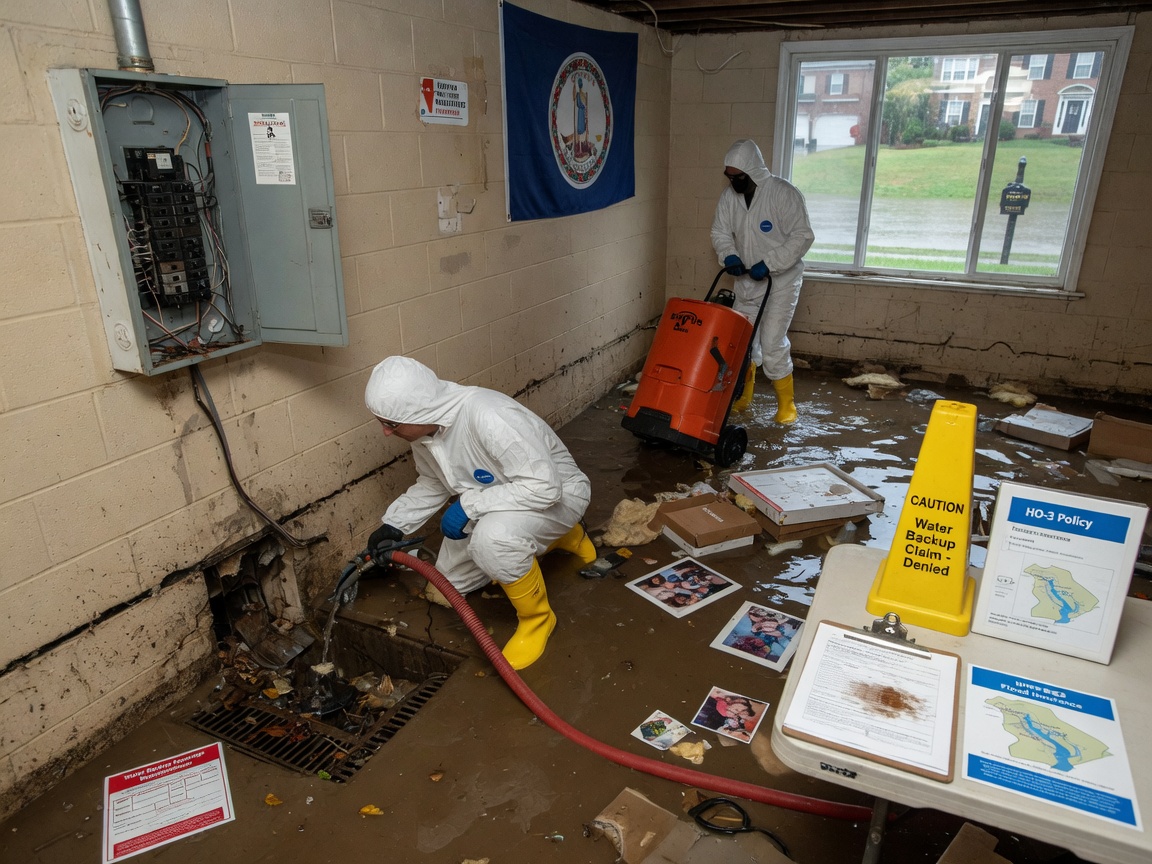
A water backup endorsement covers water that comes up through your drains, sump or sewer connection. Flood insurance covers water that arrives across the ground from outside. They are separate products, neither is included in a standard Virginia homeowners policy, and a Fairfax County homeowner with a finished basement plausibly needs both. Most people who assume they are covered for basement water have neither, and find out on the worst possible day.
The water backup endorsement is the one more people should have. It typically covers sewer backup, drain backup and sump pump failure or overflow, and in most cases it is inexpensive relative to what it protects. Coverage limits are usually capped at a set amount rather than your full dwelling limit, and those caps vary widely, so the question is not only whether you have it but whether the limit bears any relationship to what a finished basement would cost to restore. Given that a floor drain backup is one of the most common serious losses in Springfield, Annandale and the older parts of the county, this is worth five minutes on your declarations page.
Flood insurance is a different animal, usually written through the National Flood Insurance Program or a private equivalent, and it covers surface water: a creek out of its banks, overwhelmed drainage, saturated ground pushing water in at grade. That is flood damage cleanup and it runs under Category 3 protocols. In Fairfax County the properties with the clearest case sit near Accotink Creek, Difficult Run, Pohick Creek, Bull Run and, in eastern Loudoun, Sugarland Run through Herndon and Sterling. FEMA's flood maps are the reference point, and it is worth knowing that a meaningful share of flood claims nationally come from properties outside the high risk zones, so being off the map is not the same as being safe.
There is a gap between the two that catches people out, and it is groundwater seepage. Water that pushes through your foundation wall or up through the slab because the soil around your house is saturated is generally not a backup, so the endorsement often does not respond, and depending on the policy language and how the loss is characterised it may or may not be treated as flood. On Piedmont clay this is a genuinely common way for a Fairfax basement to take water. If your basement seeps rather than backs up or floods, ask your agent directly how your specific policy treats it rather than assuming.
What neither product covers is gradual damage or maintenance. A sump that has been failing progressively, a foundation that has been seeping for years, or mold that developed because a known problem was left unaddressed, all sit outside both. This is another argument for documenting and dealing with water events properly at the time, because the record of prompt mitigation is what separates a covered sudden loss from a declined maintenance claim. The general coverage rules are set out in does homeowners insurance cover water damage in Virginia.
The practical checklist. Pull out your declarations page, not the summary. Look for a water backup or sump overflow endorsement and note the limit. Check whether you hold a separate flood policy. Look up your address on the FEMA flood map. Then, if you have a finished basement and either of those is missing, price them. Both are cheap relative to restoring a finished lower level, and the decision is much easier to make on a dry afternoon than in the middle of a storm.