2026-09-12 ·
Polybutylene Pipe Failure in Northern Virginia Homes
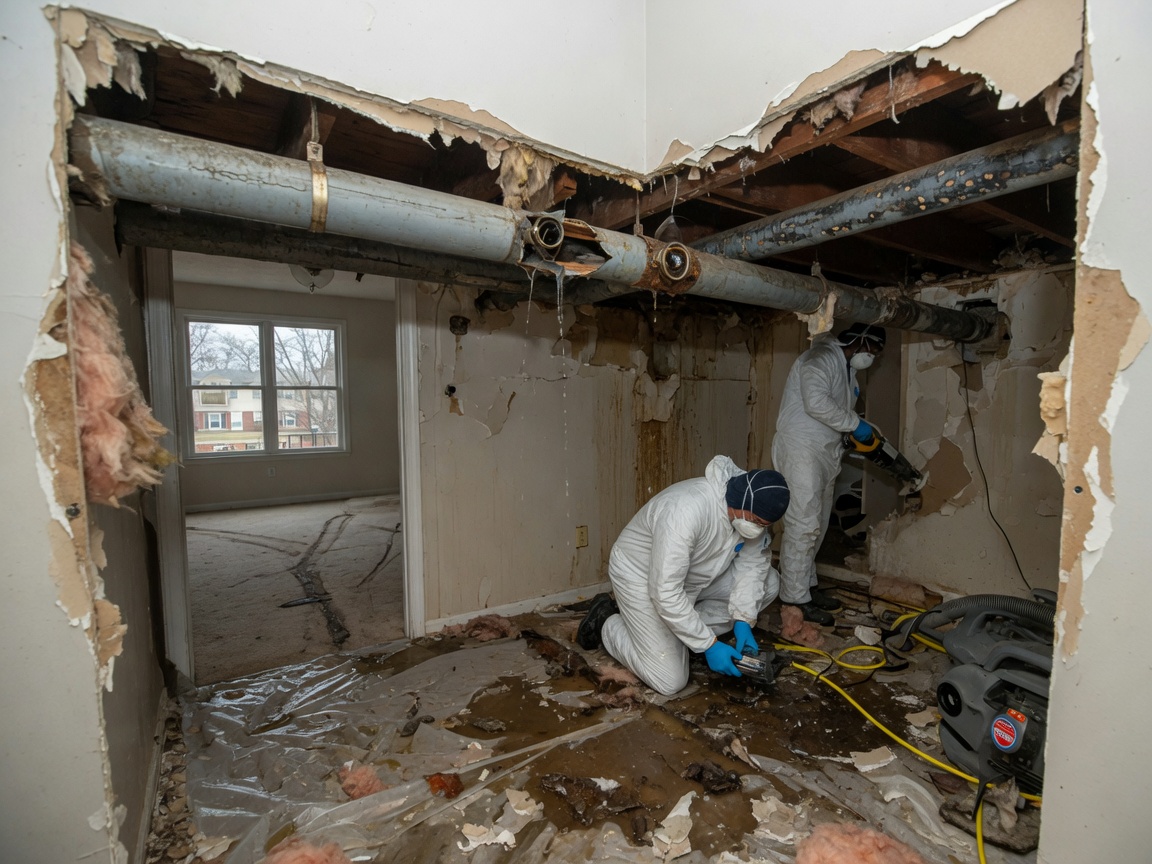
Polybutylene supply pipe was installed in American homes from roughly 1978 to 1995, it fails at the insert fittings usually with no warning leak beforehand, and Northern Virginia has a lot of it. If your home was built in that window, the fastest way to check is to look at the pipe entering your water heater or at the main shutoff: polybutylene is dull grey plastic, sometimes blue or black, typically half inch or three quarter inch, and frequently stamped PB2110.
The failure mechanism is worth understanding because it explains the suddenness. Chlorine and other oxidants in treated water attack the pipe wall from the inside, causing micro fractures that propagate outward over years. The pipe itself can hold, but the acetal insert fittings and the crimp rings at the joints degrade faster, and that is where most failures occur. There is rarely a slow drip warning phase. The joint holds until it does not, and then it releases at full supply pressure, which is why these arrive as a burst pipe emergency rather than as a slow leak.
The Fairfax County and eastern Loudoun geography of this is fairly clear because it maps to when neighbourhoods were built. Burke Centre's later phases, much of Centreville, large parts of West Springfield, the 1980s and 1990s Herndon subdivisions toward the Dulles corridor, and Sterling Park all fall squarely in the era. Older Reston clusters sit at the earlier edge of it. Homes in Annandale and older Vienna generally predate it and have galvanized steel instead, which is a different problem with the same outcome.
What to look for beyond the pipe stamp. Check the fittings rather than the pipe runs, since the fittings fail first. Look for any grey plastic pipe stub at the water heater, at the main, at exposed runs in an unfinished basement, or at the shutoff valves under sinks. Note that a house can be partly repiped, where the visible sections were replaced and the pipe inside the walls was not, which is a common and misleading situation. Where a fitting is weeping behind a finish rather than failing outright, leak detection finds it without opening walls at random.
The insurance position is generally that a polybutylene failure is a sudden and accidental event and therefore covered, and in most cases the water damage claim is paid. What is not covered is repiping the rest of the house, since that is an upgrade rather than a repair. Some carriers have also become less willing to write or renew policies on homes with known polybutylene, so a repipe can be worth doing on insurability grounds alone rather than just risk. The wider coverage picture is set out in does homeowners insurance cover water damage in Virginia.
If you decide to act before a failure, a whole house repipe in copper or PEX is the permanent answer and it is disruptive but not structurally difficult in most of this housing stock. If you decide to wait, two cheap measures reduce the damage when it happens: know exactly where your main shutoff is and make sure it actually turns, and consider an automatic leak detection shutoff valve, which pays for itself the first time the house is empty when a fitting lets go. If one does let go, emergency extraction on the first day is what keeps it from becoming a mold remediation.