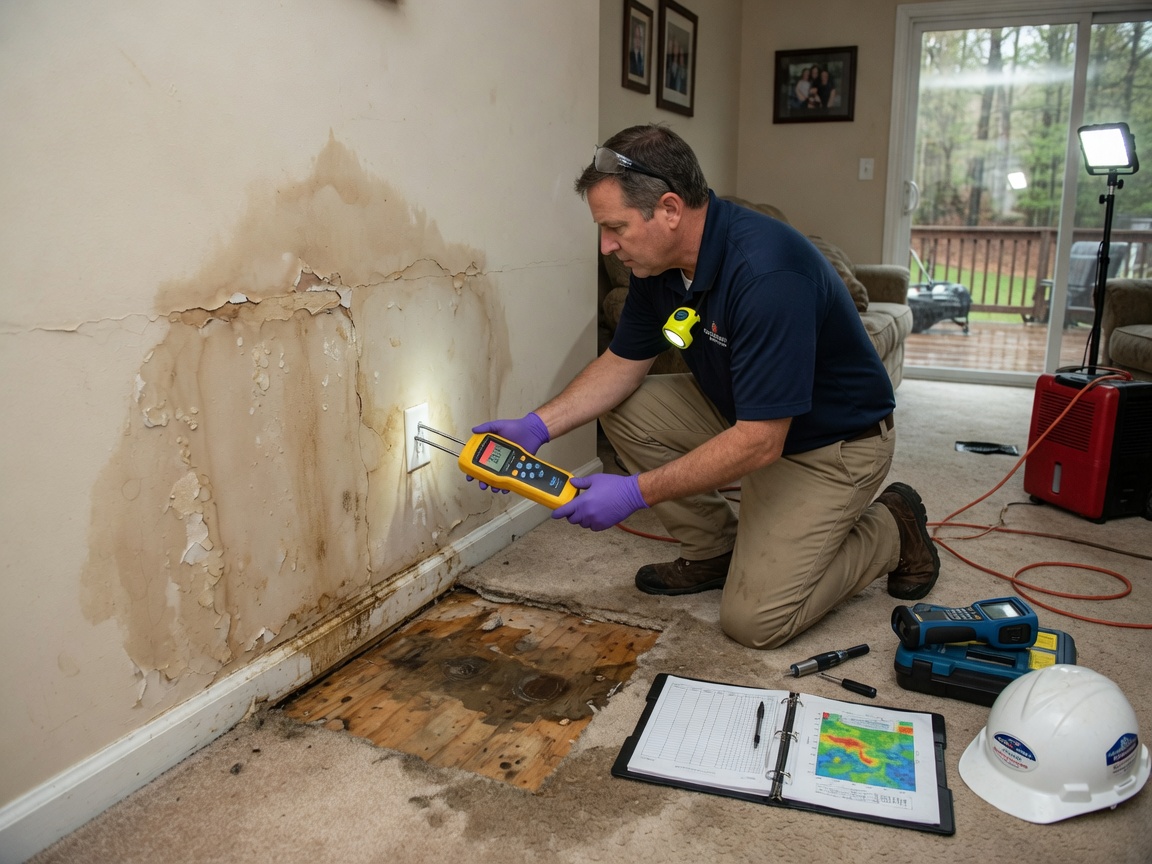
An inspection answers four questions in order: where did the water come from, what category is it, how far has it travelled, and what does it take to put the building back. Skipping any one of them produces either an oversized scope with unnecessary demolition, or an undersized one that leaves wet material behind a finished wall.
Source identification is first because an active source makes everything downstream pointless. Sometimes it is obvious. Often it is not, and the difference between a roof leak, a plumbing leak and condensation from an HVAC line is decided by where the water appears relative to weather, use patterns and the mechanical layout. Water appearing after rain and water appearing after a shower are different problems with different fixes.
Category classification determines what can be dried and what must be removed. Clean supply water can often be dried in place. Contaminated water changes the answer on every porous material in its path. Category also degrades over time, which is why a Category 1 loss discovered five days later is not treated as Category 1.
The written scope is the deliverable. It lists the affected areas with readings, the materials involved, what is being dried and what is being removed, and why. That document is what you compare against a contractor's proposal, and it is what an adjuster works from. You get it before work begins, not after.
Technician insight
Ask when the water started, then ask what the weather did in that window. A ceiling stain that appears within hours of heavy rain and never during dry weeks is a roof or flashing problem, and no amount of plumbing investigation will find it. Half of misdiagnosed water losses are solved by that one question.
Water Damage Inspection Services We Offer
✓Emergency Assessment
Same day inspection during an active loss, with immediate mitigation advice.
✓Second Opinion Inspection
Independent assessment where another contractor's scope looks larger or smaller than the damage.
✓Insurance Claim Assessment
Documentation package assembled specifically for submission to a carrier.
✓Hidden Damage Investigation
Investigating stains, odour or buckling flooring where the cause is not yet known.
How it works
- 1
Source
Where the water is coming from, and whether it is still coming.
- 2
Classify
Category assigned, factoring in how long the water has been present.
- 3
Map
Thermal and meter survey establishing the real boundary of the affected area.
- 4
Scope
Written scope with readings, materials, method and reasoning.