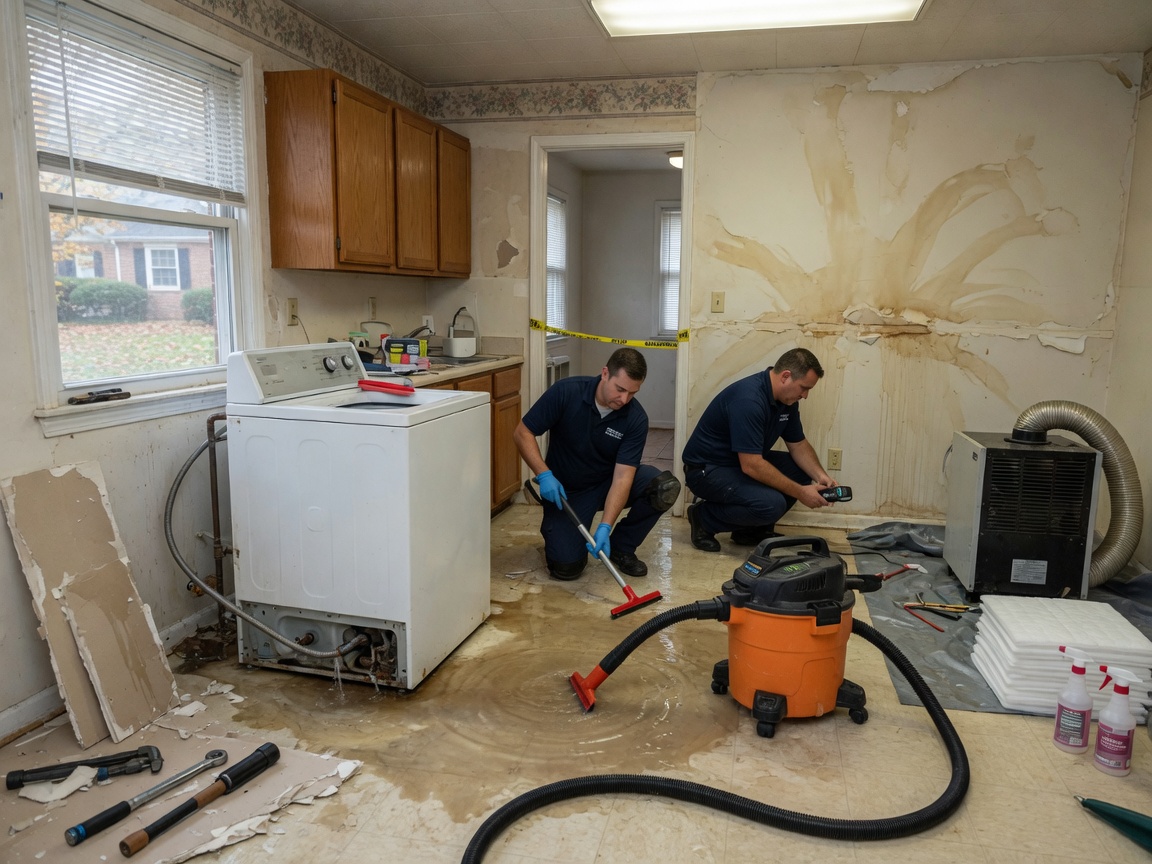
Appliance supply failures are the single most common water loss in newer Fairfax County and Loudoun housing, because the plumbing in that stock is sound and the appliances are not. Every one of these appliances has a supply connection under constant pressure and a drain connection that can block, and both sit somewhere nobody looks: behind a machine, under a counter, or against the back wall of a cabinet.
Washing machine hoses are the biggest single offender. A rubber supply hose degrades and blisters over roughly five to seven years, and when it lets go it delivers water at full pressure until someone reaches the valve. Braided stainless hoses are cheap and last far longer, and replacing rubber hoses is one of the few genuinely useful pieces of maintenance advice in this trade. Dishwashers fail at the inlet valve, the door gasket and the drain hose connection, and the water goes under the cabinet run and the adjacent flooring rather than out onto the kitchen floor where you would see it. Refrigerator icemaker lines are quarter inch plastic tubing run to the back of a heavy appliance, and they fail quietly and drip for months.
Cabinet runs make these losses worse than they look. Water under a kitchen cabinet base sits on the subfloor with a toe kick in front of it and cabinetry above it, and there is no airflow at all in that space. Particleboard cabinet bases wick water upward and swell, hardwood or laminate flooring that runs under the cabinets stays wet, and the first visible sign is often a swollen toe kick or a cupped board two rooms away.
Cleanup means getting into the cabinet run, which usually involves removing toe kicks and drilling access points for cavity drying rather than tearing out the kitchen. Where an appliance has been dripping for months rather than hours, the assessment includes mold.
Technician insight
Pull the toe kick before writing the scope on any kitchen appliance leak. The cavity behind it is where the water actually is, it has zero airflow, and a scope written from surface readings alone will be short by whatever is sitting under the cabinet base.
Appliance Leak Cleanup Services We Offer
✓Washing Machine Hose Failure
Full pressure release from a degraded rubber supply hose, often in an upstairs laundry.
✓Dishwasher Leak Cleanup
Inlet valve, gasket and drain failures that put water under the cabinet run rather than onto the floor.
✓Refrigerator Water Line Leak
Icemaker supply tubing failures behind a heavy appliance, usually a slow drip discovered late.
✓Under Cabinet Cavity Drying
Directed drying into the enclosed space beneath cabinetry, where there is no natural airflow.
How it works
- 1
Stop and isolate
Appliance valve closed, or the main if the valve is seized, which it often is.
- 2
Find the real edge
Thermal and meter survey under cabinets and into adjacent rooms.
- 3
Open the cavity
Toe kicks off and access points made so air can actually reach the wet subfloor.
- 4
Dry and assess
Drying to a dry standard, with a mold assessment where the leak was slow and long running.